
Yes, a major Apex Legends ban wave happened, and it hit hardware, not just accounts. Respawn's official anti-cheat update confirms that devices designed to manipulate input behavior, third-party adapters and spoofing peripherals included, count as cheating. Detection is immediate. Confirmed use gets a permanent ban.
Here's the part players keep missing: this isn't a normal suspension you wait out.
- Hardware-level bans (HWID) lock out the device itself, not just the login.
- A new account on the same flagged machine gets caught, often within minutes.
- Respawn has posted these numbers publicly, repeatedly, through 2026.
Quick stat check: Respawn reported nearly 6,000 hardware bans across PC and console since April, and a single seven-day sweep alone accounted for 10,909 accounts banned for cheating. If you're checking whether your device or account got swept up, start with your own login behavior and any in-client ban messages, not forum rumors.
Key Takeaways
Multiple 2026 Apex Legends ban waves confirmed hardware-level enforcement against XIM, Titan, Strikepack, and Cronus-style devices, and HWID bans persist across new accounts on the same flagged machine.
| Point | Details |
|---|---|
| Ban waves are confirmed | Respawn banned nearly 6,000 hardware-flagged accounts since April, spanning PC and console. |
| Targeted hardware is specific | XIM, Titan, Strikepack, Cronus-style devices, DMA hardware, and spoofers are all named in official posts. |
| HWID bans outlast accounts | A new account on a flagged device typically gets caught within minutes, not weeks. |
| Follow official channels | ApexLiveComms and Respawn's anti-cheat update page carry the real, verifiable numbers. |
| Appeals need documentation | Submit timestamps, screenshots, and platform details through EA's official support system. |
Table of Contents
- Apex Ban Wave Timeline: The Headline Numbers So Far
- Which Devices and Exploits Got Targeted
- How Respawn Detects Cheating: Account Bans vs. Hardware Bans
- Are Apex Bans Permanent? What Appeals Actually Look Like
- How to Check If Your Account or Device Was Banned
- What to Do If You Got Banned (and What Not to Do)
- Where to Follow Official Ban Wave Updates
- How HWID Bans Actually Work Under the Hood
- Where Norium Fits Into the Detection Conversation
- What This Ban Wave Really Signals for Competitive Apex
- Sources
Apex Ban Wave Timeline: The Headline Numbers So Far
The enforcement didn't come as a single event. It arrived in pulses, each tuned to a different device category.
January started it. Respawn rolled out detection tuned specifically to Titan-class input devices, removing more than 1,000 accounts in that window, according to DotEsports' coverage of the XIM crackdown. Six weeks later, on February 19, 2026, a second detection layer went live, targeting XIM input-spoofing devices specifically. That pass alone banned over 2,000 accounts permanently.
March brought the biggest single disclosure: 10,909 accounts banned for cheating in one seven-day period, with a category breakdown that named XIM/Titan devices, DMA hardware, other cheat hardware, and HWID spoofer flags separately, per GameRiv's reporting. By the time PCGamesN tallied the hardware-specific total, Respawn had confirmed close to 6,000 hardware bans since April, spanning both PC and console.
| Wave | Timeframe | Headline number | Primary target |
|---|---|---|---|
| Titan detection | January | 1,000+ accounts | Titan-class adapters |
| XIM detection | February 19 | 2,000+ accounts | XIM input-spoofing devices |
| Weekly sweep | March | 10,909 accounts | XIM/Titan, DMA, HWID spoofers |
| Hardware total | Since April | Nearly 6,000 hardware bans | PC and console repeat offenders |
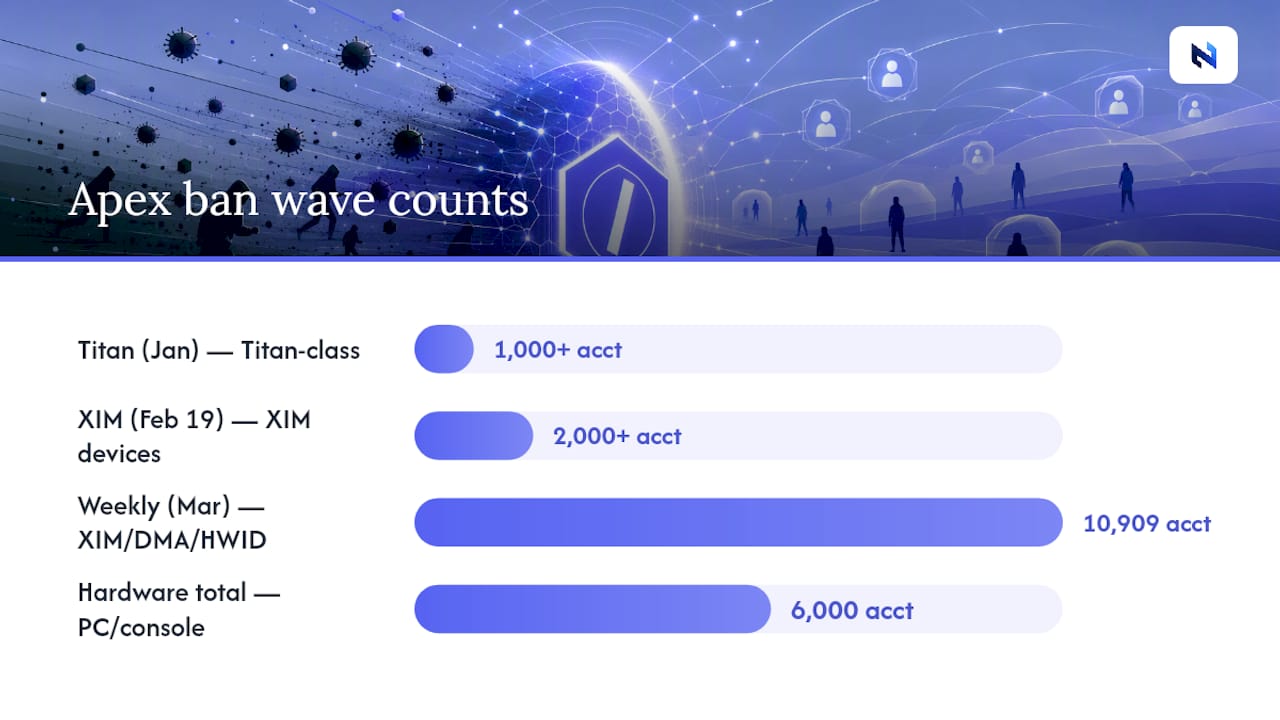
Each wave targeted a slightly different signature. The Titan pass caught adapter-based input manipulation. The XIM pass caught spoofed mouse-and-keyboard signals on console. The weekly sweep in March was broader, folding DMA (direct memory access) cheat hardware and generic HWID spoofer detections into the same report. None of this is guesswork; Respawn published the numbers itself, and ApexLiveComms amplified each figure to social channels as it happened.
Which Devices and Exploits Got Targeted
Respawn named specific hardware categories in its enforcement posts. If your setup includes any of the following, you're in the zone Respawn is actively hunting.
- XIM adapters, used to translate mouse-and-keyboard input for console play, disguised as controller signals.
- Titan-class devices, similar input-conversion hardware flagged in the January detection pass.
- Strikepack attachments, marketed for rapid-fire and recoil control on controllers.
- Cronus-style devices, general-purpose input modifiers capable of scripting, remapping, and spoofing.
- DMA (direct memory access) hardware, used to read game memory externally for ESP-style information without traditional software injection.
- Input spoofers and HWID spoofing tools, software or firmware designed to fake or rotate hardware identifiers so a banned device looks new.
Respawn also called out behavioral patterns tied to these devices, particularly "jitter aim," a recoil-compensation pattern that shows up as unnaturally consistent micro-movements during sustained fire. It's a signature, not a single tool, which is why detection can catch multiple device brands under one behavioral flag.
Pro Tip: If you're not sure whether your peripheral counts as a "modified input device," ask yourself one question: does it remap, script, or alter raw input before it reaches the game? If yes, treat it as flagged hardware, regardless of what the manufacturer calls it.
How Respawn Detects Cheating: Account Bans vs. Hardware Bans
Respawn's detection stack isn't one filter. It's layered: client-side behavioral checks, server-side pattern analysis, and device signature verification working together, with Easy Anti-Cheat handling much of the client-side enforcement.
An account ban blocks a specific login. Depending on severity, it can be temporary, tied to a single confirmed incident, or under review. A HWID ban is different in kind, not just degree. It blocks the physical device, using stable hardware identifiers that persist regardless of which account tries to log in.
Respawn's anti-cheat update is direct on this point: devices that manipulate input behavior are treated as cheating tools, and confirmed use triggers immediate, permanent enforcement. There's no tiered warning system for hardware-level violations the way there sometimes is for account-level reports.
This is why deleting your account and starting fresh usually fails. The new account touches the same flagged hardware signatures, motherboard identifiers, storage UUIDs, network adapter signatures, and gets caught almost as fast as the original. Reinstalling Windows or switching IP addresses doesn't reset these identifiers either; they're tied to physical components, not software state.
Are Apex Bans Permanent? What Appeals Actually Look Like
Confirmed hardware-device cheating gets a permanent ban, full stop. Respawn's own update language leaves little room for a lighter outcome once a device is confirmed running XIM, Titan, Strikepack, Cronus, or spoofer software. Enforcement is immediate, and the studio has shown no pattern of walking back confirmed hardware detections.
Account-level bans can be different animals. Some are permanent from the first confirmed offense. Others, tied to lower-confidence flags or first-time reports, may allow for review. The distinction matters:
- HWID bans are built to be permanent and persist across new accounts on the same machine.
- Account bans vary in duration depending on the confidence level and history behind the flag.
- Appeals go through official EA/Respawn support channels, not third-party forums or Discord rumor mills.
If you genuinely believe you were flagged in error, the process is straightforward but requires real documentation:
- Submit your appeal through EA's official support system, not social media.
- Include exact timestamps of the ban message and any in-client notifications.
- Note your platform (PC, PlayStation, Xbox) and any recent hardware changes.
- Avoid vague appeals. "I didn't cheat" without supporting detail rarely moves a case forward.
How to Check If Your Account or Device Was Banned
The symptoms differ depending on which layer got hit. An account-level ban shows up as a login failure with an explicit ban message, usually referencing the platform's standard suspension language. A hardware-level ban shows up differently: a brand-new account, created specifically to test the waters, gets banned almost instantly on the same machine.
One of the clearest signals players report is speed. Community threads on Reddit and ResetEra describe new accounts getting flagged within minutes of first launch on previously banned hardware, far faster than any behavioral review could plausibly occur.
Run these checks before assuming the worst or contacting support blind:
- Check for an explicit in-client ban message on your original account.
- Try logging in from a different, unaffected device to isolate whether it's account or hardware level.
- Cross-reference the timing against recent ApexLiveComms posts to see if your ban lines up with a known wave.
- Review any peripheral or software changes you made in the days before the ban.
Pro Tip: Screenshot everything before you contact support: the ban message, the exact date and time, your platform, and any recent hardware or peripheral changes. Appeals move faster with a clean timeline than with a frustrated paragraph.
What to Do If You Got Banned (and What Not to Do)
If you're staring at a ban message right now, the productive path is narrow but clear. Contact EA/Respawn support through official channels, document your case with timestamps and screenshots, and submit an appeal only if you have a legitimate reason to believe it's a false positive.
- Follow official support channels and submit evidence directly, not through third parties.
- Keep records of ban messages, dates, and platform details in case an appeal is warranted.
- If you manage multiple accounts on shared hardware, expect any flagged device to affect all of them.
What not to do matters just as much. Attempting to bypass a HWID ban with spoofing tools, building throwaway accounts to test enforcement, or publicly asking for bypass instructions in Discord servers or forums tends to escalate scrutiny rather than resolve it. Respawn has stated hardware bans are increasing on consoles specifically to catch repeat offenders and systems built to evade enforcement, which means a second attempt on the same hardware is more likely to get flagged, not less.
Where to Follow Official Ban Wave Updates
Three sources matter here, and everything else is secondary. Respawn's own anti-cheat update posts carry the policy language and headline numbers. ApexLiveComms handles real-time social announcements, often the first place a new wave gets confirmed publicly. In-client news panels sometimes echo major enforcement pushes directly to players.
Respawn has said explicitly that it wants players watching official channels for real-time updates, framing transparency as part of restoring trust after high-cheating periods.
Reputable outlet coverage, DotEsports, GameRiv, PCGamesN, adds useful context and category breakdowns that official posts sometimes summarize more briefly. Third-party ban trackers can be handy for aggregating numbers across waves, but treat them as secondary. Cross-check any figure against an official post or a named outlet before treating it as fact. Rumor accounts and screenshot-only claims circulating on social media are the least reliable source in this entire ecosystem.
How HWID Bans Actually Work Under the Hood
Hardware bans read specific, stable identifiers: motherboard serial numbers, storage device UUIDs, and network interface signatures among them. These get correlated server-side against previously flagged devices, which is why the ban follows the machine rather than the login.
| Identifier type | What it identifies | Why it's hard to fake reliably |
|---|---|---|
| Motherboard serial | Physical system board | Fixed at manufacture, rarely spoofable without firmware-level access |
| Storage UUID | Drive-level identifier | Persists across OS reinstalls unless the drive itself changes |
| NIC signature | Network adapter identity | Tied to hardware, not IP address, so VPNs don't help |
This is also why reinstalling an operating system or rotating IP addresses generally does nothing for a HWID flag. The identifiers being checked live below the OS layer or on components that survive a clean install entirely.
A community writeup on the topic put it plainly: HWID bans are built to persist specifically because account-level and IP-level bans proved too easy to route around.
Spoofing tools that fake these identifiers exist, but they're a moving target. Anti-cheat teams track new spoofer signatures as they surface and push detection updates against them, meaning a spoofer that works today can be flagged next patch. Historical reporting on Apex's hardware-ID enforcement shows this pattern repeating across multiple prior campaigns, not just the current wave, per PC Gamer's coverage of Respawn's hardware-ID measures.
Where Norium Fits Into the Detection Conversation
Norium doesn't sell bypass tools for confirmed HWID enforcement, and no legitimate service can promise immunity from a hardware-level flag once it's set. What Norium does track is detection status across supported titles, live, not on a delay, so buyers understand current risk before they act.
- Live detection status updates, checked against known anti-cheat behavior, not guesswork.
- Human Discord support instead of automated ticket queues when a key fails to activate.
- A 24-hour refund window if a purchased key doesn't activate as described.
Players researching Apex cheat categories or comparing aimbot and ESP options should treat detection status as a live variable, not a fixed guarantee, given how fast Respawn has been shipping new detection passes in 2026. For a broader look at how detection systems function across titles, the anti-cheat explainer breaks down EAC, BattlEye, and Vanguard side by side. Anyone weighing supplier risk more generally can start with the guide to picking a safe cheat provider, or check the live detection status page before making a purchase decision.
What This Ban Wave Really Signals for Competitive Apex
The scale here is different from past cleanup efforts. Nearly 6,000 hardware bans since April, on top of the XIM and Titan-specific passes earlier in the year, suggests Respawn shifted from reactive account bans toward device-level enforcement built to actually stick. That's a meaningfully different commitment than a quiet quarterly ban sweep.
What matters most going forward isn't the raw ban count. It's whether Respawn keeps publishing numbers through ApexLiveComms at the same pace. Transparency is what turns a ban wave from a one-time headline into evidence of sustained enforcement, and the community has clearly been watching for exactly that pattern after past periods of frustration with unchecked cheating.
If you're an unaffected player wondering what to do with any of this: watch official channels, not forums, and don't experiment with bypass tools on hardware you care about keeping. The detection net has gotten measurably tighter in 2026, and betting against that trend is a bad wager.
Sources
Every headline figure in this explainer traces back to an official post or a named outlet report, not aggregated rumor.
- Apex Legends™: Anti-Cheat Update
- Apex Legends launches big XIM crackdown, over 2,000 accounts permanently banned
- Apex Legends Anti Cheat Team Bans 10,909 Accounts, Targets XIM/Titan, DMA, and Spoofers - GameRiv
- Apex Legends devs dole out nearly 6,000 hardware bans in anti-cheat crackdown on "malicious bad actors"
Third-party ban trackers can aggregate these figures into charts, which is genuinely useful for spotting trends over time. Treat them as a convenience layer, though, and confirm any specific number against one of the four sources above before repeating it as fact.